


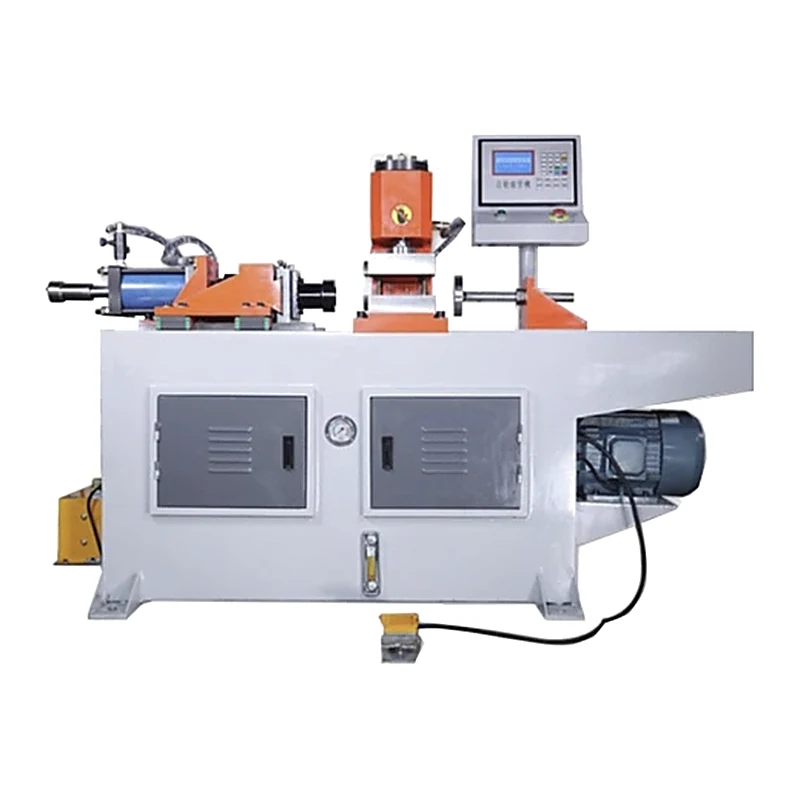
Double Head Pipe End Forming Machine
A double head pipe end forming machine forms both ends of the tube in the same cycle. Two opposed forming heads close on the part simultaneously, so one loading produces a finished piece instead of two loadings and a turnaround.
The gain is not only cycle time. When both ends are formed against the same fixture in one clamping, the finished length is set by the machine rather than by how accurately an operator positions the part for the second pass. On parts where overall length is a tolerance, that difference is the whole reason to buy the machine.
Where a Double Head Pays Back
Both ends need the same operation. Furniture rails reduced at each end, scaffolding tube swaged both ends, exhaust sections flared both ends — this is the classic case.
Overall length is a controlled dimension. Forming both ends in one clamping removes the accumulated error of positioning the part twice.
Volume is steady on one part number. Head spacing is set for a given part length, so the machine earns its keep on repeat production rather than on short varied batches.
When a Single Head Is the Better Buy
If your parts vary widely in length, the head spacing has to be reset between jobs, and the handling you saved comes back as setup time.
If each end needs a different operation — reduced one end, flared the other — a double head machine needs different tooling in each head, which is workable but raises the tooling cost and complicates changeover.
And if only one end of the part is formed at all, a double head machine buys you nothing. The single head TM series is the cheaper and simpler machine, and we will say so if that is what your drawing shows.
Technical Specifications
| Model | TM-40 | TM-60 | TM-80 | TM-100 |
| Max tube, carbon steel | Ø40 × 2.0 | Ø60 × 2.0 | Ø80 × 2.0 | Ø100 × 2.0 mm |
| Max working stroke per head | 110 | 110 | 120 | 120 mm (extendable) |
| Working speed | 80 | 70 | 60 | 60 mm/sec |
| Max hydraulic pressure | 12 | 12 | 14 | 14 MPa |
| Motor power | 4.0 | 5.5 | 7.5 | 11 kW |
| Pump displacement | 17 | 23 | 32 | 50 L |
| Machine weight | 800 | 1,000 | 1,300 | 1,500 kg |
| Dimensions (L×W×H) | 2000×900×1200 | 2200×900×1500 | 2900×1100×1600 | 3000×1100×1600 mm |
| Part length range (head spacing) | [n] – [n] mm | |||
| Stations per head | 1 (multi-station on request) | |||
| Control | PLC, hydraulic drive, mobile foot switch | |||
| Power supply | 380 V / 50 Hz / 3-phase (configurable) | |||
Capacity, stroke, and power match the single-head TM series of the same model number. What differs is the second forming head and the head spacing, which is configured to your part length. Send the finished length, the tube size, and the operation required at each end, and we will confirm the build before quoting.
Forming Operations
Reducing, expanding, flaring, flanging and chamfering — the same range as the single head machines. Which operation a head performs is set by the tooling fitted, and the two heads can carry different dies where the part calls for it.
Because a double head machine needs two die sets rather than one, tooling is a larger share of the package than on a single head. Send the drawing of each finished end so the quote reflects the real cost of getting into production.
Thin Wall Tube, Not Schedule Pipe
These machines are built for welded and drawn tube used in furniture, fitness equipment, automotive exhaust, HVAC, and scaffolding. They are not rated for Schedule 40 or Schedule 80 pipe, where wall thickness runs several times higher.
Tell us the wall thickness before you order rather than after. We would rather lose a quote than ship a machine that cannot do the job.
Applications
Furniture and shop fittings. Chair and table rails reduced at both ends, shelving cross members, display rack tubing.
Scaffolding and access equipment. Tube swaged at both ends to telescope into the next section.
Automotive. Exhaust sections expanded or flared at both ends for slip joints.
HVAC and refrigeration. Connector tubes belled at both ends for brazed joints.
On parts that are bent as well as end-formed, the machine pairs with our CNC pipe bending machines — bend first, form the ends after.
Tooling, Installation and Support
Die sets are specific to tube diameter, wall and the finished form, and a double head machine takes a set per head. Changeover is quick once set up, but plan the head spacing around the part lengths you run most.
Installation and operator training are available on site or remotely by video call. Wear items and hydraulic seals ship from stock. Warranty is [n] months on the machine and [n] months on the control system.
Frequently Asked Questions
How much faster is a double head machine?
It removes one loading and one turnaround per part. On short cycle work where handling dominates, throughput close to doubles; where the forming stroke itself is the long part of the cycle, the gain is smaller.
Can the two heads perform different operations?
Yes, with different tooling in each head — reduced at one end and flared at the other, for example. It raises tooling cost, so tell us at the quoting stage rather than later.
Can it run parts of different lengths?
Within the head spacing range, yes — the spacing is adjusted between jobs. Frequent changes eat into the handling time the machine saves, so a wide mix of lengths often suits a single head machine better.
Is this a CNC machine?
No. It is PLC-controlled with hydraulic drive. Forming position is set by the die and the stroke limit rather than by a stored program.
How long is delivery?
Standard lead time is [n] working days after deposit and tooling confirmation. Head spacing configured to a non-standard length may add [n] days.
Send the finished part drawing — tube OD, wall thickness, material grade, overall length and the operation required at each end — along with your annual volume. We will confirm the configuration and quote within 24 hours.
Reviews
There are no reviews yet.