


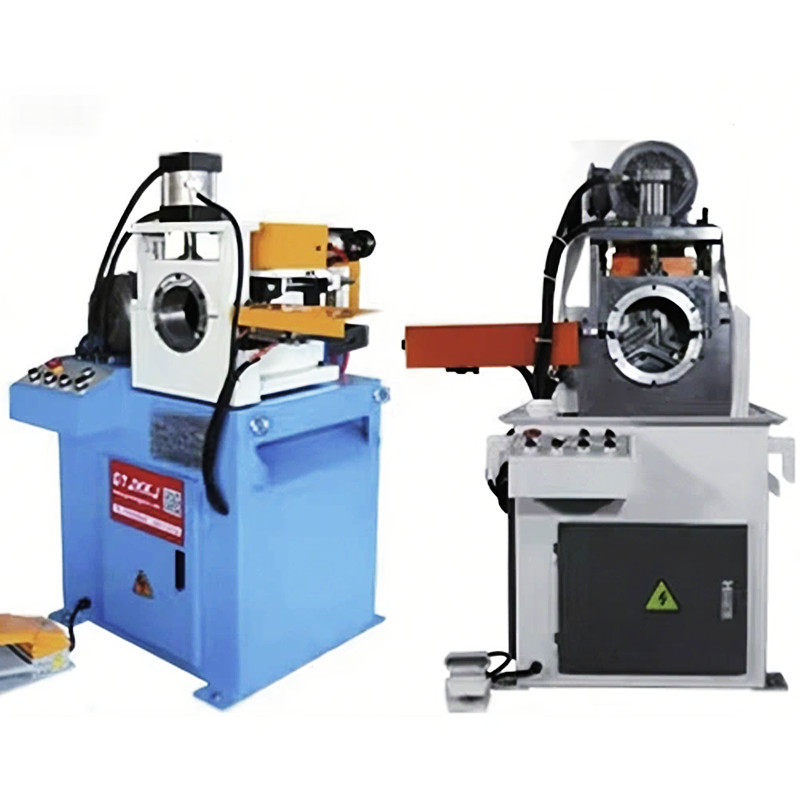
Pipe Chamfering Machine — AC Series, Single Head
The AC series is a pneumatic pipe chamfering machine that cuts the inside corner, the outside corner and the face of a tube end in one pass. Five models cover Ø8 mm to Ø230 mm, at wall thickness from 1 mm to 10 mm, holding ±0.1 mm in a 3 to 5 second cycle.
Feed and retract are automatic on a foot pedal. The operator loads the tube, presses the pedal, and the cutter head advances, machines the end and withdraws.
Three Surfaces in One Operation
The cutter head carries three independent tools: an inner corner knife, an outside corner knife and a flat knife. All three engage together, so the inner chamfer, the outer chamfer and the squared face are finished in a single stroke — or any one of them alone if that is all the part needs.
This is what separates a chamfering machine from a deburring wheel. A wheel knocks the burr off and leaves an inconsistent edge. A cutter head produces a specified chamfer angle on both bore and outside diameter, repeatably, which is what a welded joint or a press-fit assembly actually requires.
Inner knife position is set with an adjustment screw and the holders lock from the side, so changing between part sizes is a setting rather than a tooling change.
Model Range
| Model | AC-60A | AC-80A | AC-120A | AC-180A | AC-230A |
| Tube OD | Ø8–60 | Ø10–80 | Ø30–120 | Ø30–180 | Ø50–230 mm |
| Wall thickness | 1–2 | 1–3 | 1–4 | 1–4 | 1–10 mm |
| Min part length | 40 | 40 | 100 | 100 | 100 mm |
| Motor power | 0.75 | 1.5 | 2.2 | 4.0 | 5.5 kW |
| Cycle time | 3–5 | 3–5 | 3–5 | 3–5 | 5–9 sec/pc |
| Weight | 140 | 220 | 300 | 370 | 800 kg |
| Dimensions (mm) | 770×650×1100 | 850×880×1100 | 900×1000×1300 | 1200×1100×1450 | 1200×1600×1700 |
| Machining accuracy | ±0.1 mm across the range | ||||
| Air pressure | 0.6 – 0.8 MPa (87 – 116 psi) | ||||
| Power supply | 380 V / 50 Hz / 3-phase standard; 220 V or 480 V / 60 Hz built to order | ||||
Shorter part lengths than the minimum shown can be accommodated on the AC-60A and AC-80A with custom fixturing. Send the part length with your enquiry.
Choosing the Model
Two figures decide it: your largest tube diameter and your heaviest wall. Note that wall capacity does not rise evenly with diameter — the AC-120A and AC-180A both stop at 4 mm, and only the AC-230A reaches 10 mm. If you run heavy wall on moderate diameter, size on the wall column, not the diameter column.
Minimum part length matters too, and it is the figure buyers most often overlook. The AC-120A and above need 100 mm of tube to grip and machine. Short parts belong on the AC-60A or AC-80A.
Indexable Inserts, and What They Cost to Run
The cutter head takes standard indexable carbide inserts — triangular, flat or R-angle depending on the edge you want. Triangular inserts carry three usable cutting edges: when one dulls, loosen the screw, rotate the insert and carry on.
That matters more than it sounds over a production year. Three edges per insert cuts your consumable cost to a third of what a single-edge tool would run, and the inserts themselves are a standard commodity rather than a proprietary part you can only buy from us.
An R-angle insert produces a radiused edge instead of a chamfer, which some applications specify for stress or sealing reasons. Tell us the edge geometry on your drawing and we will supply the right insert with the machine.
Materials
Carbon and stainless steel tube, copper, brass and aluminum tube, and solid round and hex bar within the diameter range. The cutter head does not care what the section is as long as the clamping die grips it — tell us if you run hexagonal or square stock so the fixture is specified correctly.
Where It Sits in the Line
Every saw cut leaves a burr on the inner and outer edge. On a part that is welded, end formed or assembled into another section afterwards, that burr has to come off, and on thin wall it has to come off without distorting the tube.
The chamfering machine sits immediately after the saw. Cut on a CNC cutting machine or pneumatic saw, chamfer here, then end form or bend. A clean chamfered end also feeds into an end forming die far more reliably than a burred one.
Applications
Weld preparation. Beveled ends for butt welds on process pipework and fabricated assemblies.
Furniture and fitness equipment. Deburred tube ends on frames that are handled by assembly staff and end users.
Automotive. Exhaust and fluid line ends prepared for slip joints and sealing faces.
Hydraulics and pneumatics. Bore chamfers so a fitting or O-ring enters without shaving.
Machining shops. Bar stock end preparation ahead of turning or threading.
Installation and Support
The machine needs compressed air at 0.6–0.8 MPa for clamping and feed. Confirm your compressor sustains that during continuous production rather than only at idle.
The smaller models are bench-scale at 140 to 300 kg and move with a pallet truck. Inserts, clamping dies and seals ship from stock. Installation and operator training are available on site or remotely. Warranty is [n] months.
Frequently Asked Questions
What is a pipe chamfering machine used for?
Machining the end of a tube or bar so it is square, deburred and chamfered on the bore and the outside diameter — usually to prepare for welding, assembly or a sealing face.
Can it chamfer inside and outside at the same time?
Yes. The cutter head carries an inner knife, an outer knife and a flat knife working together in one stroke. Any one can also be used on its own.
What is the shortest part it can handle?
40 mm on the AC-60A and AC-80A, 100 mm on the larger models. Shorter parts can be run with custom fixturing — send the part length and we will confirm.
Can it machine solid bar as well as tube?
Yes, round and hex bar within the diameter range. The inner knife simply has nothing to cut on solid stock.
What inserts does it use?
Standard indexable carbide inserts — triangular, flat or R-angle. Triangular inserts give three cutting edges each, which is what keeps the running cost down.
Can it be built for 60 Hz?
Yes. Standard build is 380 V / 50 Hz three-phase; 220 V or 480 V at 60 Hz is available to order. Specify your supply with the enquiry.
How long is delivery?
Standard lead time is [n] working days after deposit.
Send your tube OD, wall thickness, part length, material and the chamfer angle on your drawing, and we will confirm the model and insert specification and quote within 24 hours.
Reviews
There are no reviews yet.