


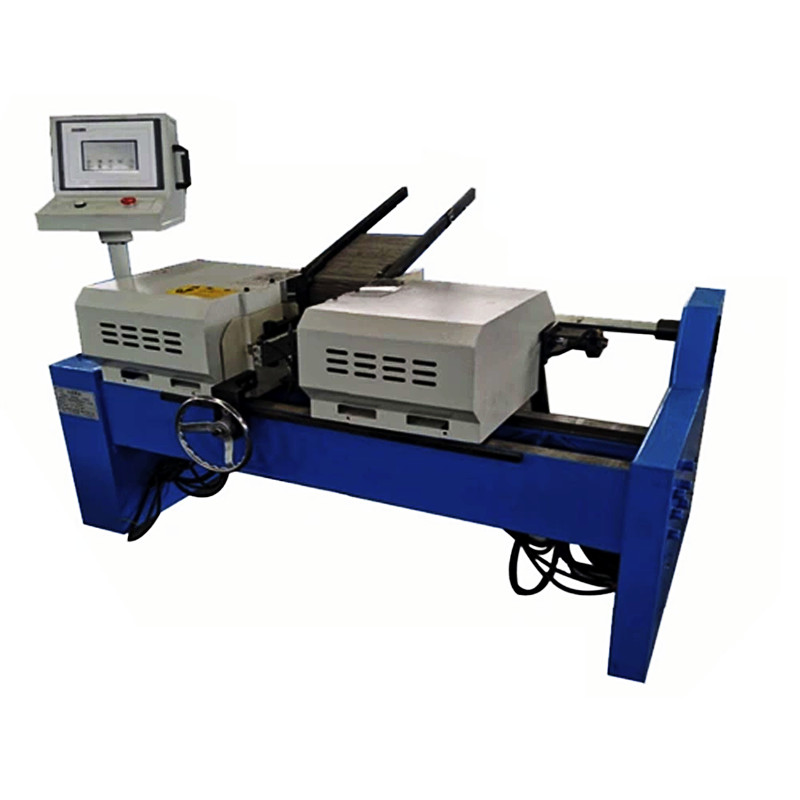
Double Head Chamfering Machine — BC-30
The BC-30 is a double head chamfering machine that finishes both ends of a tube in the same cycle. Two opposed cutter heads advance together, each machining the inner corner, the outer corner and the face, and the part comes off complete in 3 to 5 seconds.
It is built for a specific job: short small-diameter parts in volume. Tube from Ø8 to Ø30 mm, 1 to 3 mm wall, 100 to 245 mm long, held to ±0.1 mm.
Technical Specifications
| Tube outside diameter | Ø8 – Ø30 mm |
| Wall thickness | 1 – 3 mm |
| Part length | 100 – 245 mm |
| Machining accuracy | ±0.1 mm |
| Cycle time | 3 – 5 sec per piece, both ends |
| Motor power | 0.75 kW |
| Air pressure | 0.8 MPa (116 psi) |
| Machine weight | 600 kg |
| Dimensions (L × W × H) | 1,600 × 1,500 × 1,800 mm |
| Cutter head | Inner, outer and flat knife per head |
| Power supply | 380 V / 50 Hz / 3-phase standard; 220 V or 480 V / 60 Hz built to order |
Three Surfaces, Both Ends, One Cycle
Each head carries an inner corner knife, an outside corner knife and a flat knife. All three engage together, so the bore chamfer, the outside chamfer and the squared face are finished in one stroke — and because there are two heads, that happens at both ends simultaneously.
A single head machine producing the same part needs two loadings and a turnaround. At 3 to 5 seconds of machining time, the handling is the cycle — so removing one loading is close to halving the time per part.
There is a quality argument too. Both ends are machined against the same fixture in one clamping, so the finished length and the squareness of one end relative to the other are set by the machine rather than by how the operator positioned the part for a second pass.
The Working Window Is Narrow — Check It First
This machine takes parts between 100 mm and 245 mm long, from Ø8 to Ø30 mm, at 1 to 3 mm wall. That is a tighter window than most buyers expect from a machine of this size, and it is the first thing to check against your drawing.
If your parts are longer than 245 mm, larger than Ø30, or vary widely in length from batch to batch, the single head AC series is the machine to look at — it reaches Ø230 mm and up to 10 mm wall, and has no upper length limit.
And if only one end of your part is chamfered, a double head buys you nothing. We would rather say that now than after the order.
Indexable Inserts
Both heads take standard indexable carbide inserts — triangular, flat or R-angle depending on the edge specified. Triangular inserts carry three usable cutting edges: when one dulls, loosen the screw, rotate and carry on.
Note that a double head machine consumes inserts at twice the rate of a single head, since both ends are being cut. Factor that into the running cost when you compare the two — it does not change the conclusion on a high-volume part, but it should be in the calculation.
Applications
Hydraulic and pneumatic lines. Short rigid tube runs chamfered both ends for fittings and O-ring seals.
Furniture and shop fittings. Cross members and connector tubes that telescope or bolt at both ends.
Heat exchangers and refrigeration. Copper and stainless connector tubes prepared for brazing at both ends.
Automotive and machinery. Spacers, bushings and short tube components handled in volume.
Materials
Carbon and stainless steel, copper, brass and aluminum tube, and solid round or hex bar within the diameter range. Tell us if you run non-round section so the clamping dies are specified correctly.
Where It Sits in the Line
Directly after the saw. Every cut leaves a burr on the inner and outer edge, and on a part that is brazed, welded or fitted into an assembly afterwards it has to come off cleanly at both ends.
Cut on a pneumatic saw or CNC cutting machine, chamfer here, then end form or bend. A chamfered end also enters an end forming die far more reliably than a burred one.
Installation and Support
The machine needs compressed air at 0.8 MPa for clamping and feed. Confirm your compressor sustains that during continuous production rather than only at idle.
At 600 kg and a 1,600 × 1,500 mm footprint it positions with a pallet truck and needs no foundation. Inserts, clamping dies and seals ship from stock. Installation and operator training are available on site or remotely. Warranty is [n] months.
Frequently Asked Questions
How much faster is a double head chamfering machine?
It removes one loading and one turnaround per part. Machining takes 3 to 5 seconds, so on this class of part handling dominates the cycle and the saving is close to half.
What part lengths does it accept?
100 to 245 mm. Outside that range, use the single head AC series.
Can the two heads cut different chamfer angles?
Yes, with different inserts in each head. Send the drawing showing both ends and we will specify the tooling.
Does it chamfer inside and outside together?
Yes. Each head carries an inner knife, an outer knife and a flat knife working in one stroke, and any of them can be used alone.
Can it be built for 60 Hz?
Yes. Standard build is 380 V / 50 Hz three-phase; 220 V or 480 V at 60 Hz is available to order.
How long is delivery?
Standard lead time is [n] working days after deposit.
Send your tube OD, wall thickness, part length, material and the chamfer specified at each end, and we will confirm the configuration and quote within 24 hours.
Reviews
There are no reviews yet.