


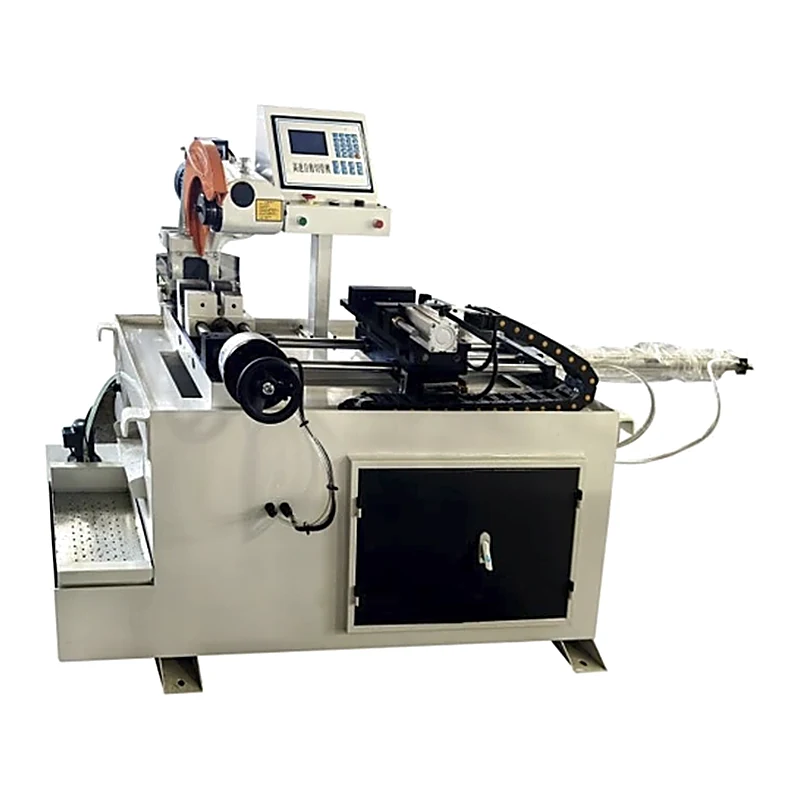
Pneumatic Pipe Cutting Machine — MC-325NC
The MC-325NC is a pneumatic pipe cutting machine that clamps the tube and feeds the saw head on air cylinders, cutting with an HSS circular blade. There is no hydraulic power pack, no oil to change and no pump running between cuts — the machine draws air only when a cylinder moves.
It cuts round tube to Ø90 × 5 mm, square to 80 × 80 × 4 mm, angle to 90 × 90 × 5 mm and solid bar to Ø30 mm, at 90°. Clamping and feed are automatic; cut length is set by a manual stop plate.
Cutting Capacity
| Section | 90° cut | 45° cut |
| Round tube | Ø90 × 5 mm | Ø60 × 5 mm |
| Square tube | 80 × 80 × 4 mm | 50 × 50 × 4 mm |
| Angle section | 90 × 90 × 5 mm | 50 × 50 × 5 mm |
| Rectangular tube | 60 × 80 mm | 45 × 60 mm |
| Solid round bar | Ø30 mm | Ø25 mm |
| Solid square bar | 25 × 25 mm | 25 × 25 mm |
Note how much capacity an angled cut costs. At 45° the round tube limit drops from Ø90 to Ø60, because the blade travels through a longer section of material. If mitre cuts are part of your production, size the machine on the 45° column, not the 90° one — this is the single most common sizing mistake on saw purchases.
Technical Specifications
| Cutting mode | Automatic |
| Clamping | Unilateral, automatic |
| Feeding | Pneumatic |
| Length positioning | Manual stop plate |
| Feeding effective stroke | 600 mm |
| Saw blade diameter | Ø250 – Ø350 mm |
| Blade sizes accepted | 250 / 275 / 315 / 325 / 350 mm |
| Blade type | HSS circular saw |
| Spindle speed | 60 / 120 rpm (two speed) |
| Main motor power | [n] kW |
| Coolant pump | 40 W, recirculating |
| Air pressure required | 0.4 – 0.8 MPa |
| Machine weight | 800 kg |
| Dimensions (L × W × H) | 2,000 × 800 × 1,400 mm |
| Power supply | 380 V / 50 Hz / 3-phase (configurable) |
Capacity figures are for carbon steel. Stainless and harder alloys call for a low spindle speed and a different blade specification — send your material grade with the enquiry.
Two Spindle Speeds, and Why They Matter
The spindle runs at 60 or 120 rpm. High speed is for mild steel and thin wall, where a faster blade clears the cut quickly and keeps cycle time down. Low speed is for stainless, thicker wall and solid bar, where feeding too fast work-hardens the material ahead of the tooth and destroys the blade.
Blade cost is the main consumable on any cold saw. Running stainless at the high-speed setting is the fastest way to turn a working blade into scrap, and it is the most common operator error we see. Training covers it.
How the Cut Length Is Set
Feed is pneumatic with a 600 mm effective stroke, and the cut length is set by a manual stop plate. Repeatability comes from the stop and from consistent loading against it, not from a stored program — which is exactly why the machine costs what it does.
For one or two fixed lengths run all day, this is the right arrangement. Set the stop once in the morning and the machine repeats it. Where cut lengths change several times a shift, or where length is a tight tolerance on the drawing, a servo-fed CNC cutting machine programs the feed instead and removes the setup step entirely.
Pneumatic, Hydraulic or CNC
Pneumatic. Thin-wall tube, high volume, one or two part lengths. Lowest purchase price, lowest running cost, quickest to set up. Clamping force is limited by air pressure, so heavy wall sits outside its range.
Hydraulic. Thicker wall and larger diameter, where an air cylinder cannot deliver the clamping and feed force required. Higher price, a power pack to maintain, oil to manage.
CNC with servo feed. Where cut lengths change frequently, or a batch contains many different lengths. Changeover becomes a keystroke rather than a fixture adjustment.
If you cut one or two lengths of thin-wall tube all day, the pneumatic machine does the job for a fraction of the cost of the alternatives. We will tell you when it will not.
Cut Quality and What Comes After
A cold saw cuts rather than abrades, so there is no discolouration band and no hardened heat-affected edge — unlike an abrasive chop saw. The end comes off square with a clean surface.
It does leave a burr on both the inner and outer edge, as every saw cut does. If the tube is afterwards end-formed, welded, or inserted into another section, that burr has to come off. Most workshops handle it with a chamfering or deburring machine downstream — worth settling before the machine arrives rather than after.
Applications
Furniture and shop fittings. Chair and table frame components, shelving uprights, display racks.
Fitness equipment. Frame tubing cut to repeat lengths in volume.
Automotive. Exhaust sections, seat frame tube, roll cage stock.
Structural fabrication. Angle and square section for frames, racking and light steelwork.
In a typical line the saw sits ahead of the bender and the end former: cut to length, form the ends, then bend. Our CNC pipe bending machines and end forming machines are built to work alongside it.
Installation and Support
The machine needs compressed air at 0.4–0.8 MPa. Check that your compressor holds that pressure under continuous cutting, not just at idle — this is the most common commissioning problem on pneumatic machines, and it is far easier to resolve before shipment than after.
Blades, coolant and seals ship from stock. At 800 kg, the machine is positioned with a forklift and needs no foundation. Installation and operator training are available on site or remotely. Warranty is [n] months.
Frequently Asked Questions
What is a pneumatic pipe cutting machine used for?
Cutting tube, section, and light bar to repeat lengths in production. Air cylinders clamp the work and feed a circular saw blade; the cut length is set by an adjustable stop plate.
What is the maximum cut length?
The effective feeding stroke is 600 mm per cycle. Longer pieces are produced by repositioning the stock, so if most of your parts exceed 600 mm, tell us and we will point you to a machine with a longer feed.
How accurate is the cut length?
Repeatability depends on the stop setting and on loading the stock firmly against it. For tolerances tighter than a manual stop can hold, a servo-fed CNC cutting machine is the right tool.
Can it cut at 45 degrees?
Yes, with reduced capacity — Ø60 × 5 mm round tube against Ø90 × 5 mm at 90°. See the capacity table for each section type.
Can it cut stainless steel?
Yes, at the 60 rpm setting with a blade specified for stainless. Expect higher blade consumption than carbon steel, and tell us the grade so we can supply the right tooth geometry.
Which blade size should I use?
The machine takes 250, 275, 315, 325, and 350 mm blades. Larger diameters reach the full capacity; smaller ones cost less per blade and suit small sections. We will specify with the quote.
Does it leave a burr?
Yes, on both inner and outer edges, as any saw cut does. If the part is welded or assembled afterwards, you will need a deburring or chamfering operation downstream.
How long is delivery?
Standard lead time is [n] working days after deposit.
Send your tube OD, wall thickness, section type, material grade, cut length and daily output, and we will confirm the model and blade specification and quote within 24 hours.
Reviews
There are no reviews yet.