


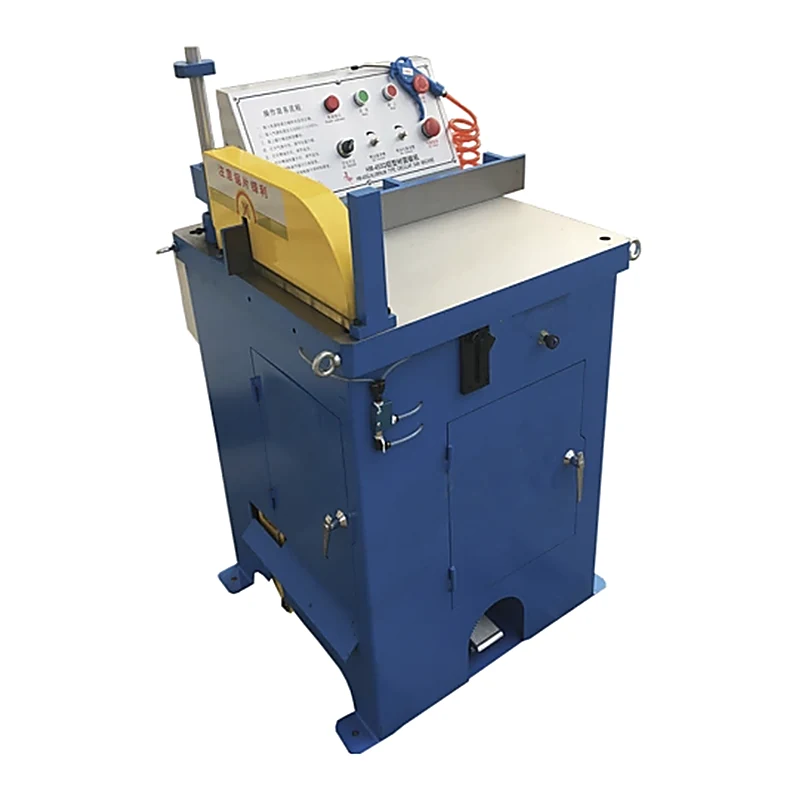
Aluminum Pipe Cutting Machine — MC455NC
The MC455NC is a semi-automatic aluminum pipe cutting machine running a Ø455 mm tungsten carbide blade at 2,800 rpm. It cuts profile up to 120 mm (4.7″) high and 260 mm (10.2″) wide — round tube, square and rectangular section, and extruded profile.
Clamping and the saw stroke are pneumatic; the operator positions the stock and sets the length by hand. At 350 kg (772 lb) the machine needs no foundation and moves on a pallet truck.
Why Aluminum Needs a Different Machine
A steel cold saw runs its blade at 45 to 120 rpm. This machine runs at 2,800 rpm — nearly two orders of magnitude apart, and the reason the two cannot be treated as interchangeable.
Aluminum is soft and cuts cleanly at high surface speed with a tungsten carbide tooth. Run it slowly on an HSS cold saw and the material smears rather than chips. Run steel at 2,800 rpm with a carbide blade and the blade is finished within a handful of cuts.
If you cut both aluminum and steel in volume, you need two machines. Anyone offering one machine that does both properly is describing a compromise, and the cost of that compromise shows up in blade consumption.
Technical Specifications
| Max cutting height | 120 mm (4.7″) |
| Max cutting width | 260 mm (10.2″) |
| Saw blade diameter | Ø455 mm (18″) |
| Blade sizes accepted | 405 / 455 mm (16″ / 18″) |
| Blade type | Tungsten carbide tipped (TCT) |
| Spindle speed | 2,800 rpm |
| Main motor power | [n] kW |
| Cutting mode | Automatic saw stroke |
| Clamping | Pneumatic, top and bottom |
| Feeding and length setting | Manual |
| Lubrication | Air and oil mist |
| Air pressure required | 0.4 – 0.8 MPa (58 – 116 psi) |
| Machine weight | 350 kg (772 lb) |
| Dimensions (L × W × H) | 1,500 × 800 × 1,400 mm (59 × 31.5 × 55″) |
| Power supply | 380 V / 50 Hz / 3-phase standard; 220 V or 480 V / 60 Hz built to order |
| Outfeed roller rack | Optional |
Air and Oil Mist Lubrication
The machine sprays an air and oil mist at the cut rather than flooding it with water-based coolant. On aluminum this is not a cheaper substitute — it is the correct method.
Aluminum welds itself to the cutting edge under heat, building up on the tooth face until the blade stops cutting and starts rubbing. The result is a rough end, a heavy burr and a blade that comes off far earlier than it should. A light oil film on the tooth prevents that adhesion. Flood coolant does not, and it leaves wet swarf that is awkward to recycle.
The system also keeps chips clear, and the built-in air gun blows the table down between cuts. Aluminum swarf is light and clings to everything — on a busy machine this matters more than it sounds.
Manual Feed, and When That Is the Right Choice
The operator positions the stock and sets length against a stop by hand. Repeatability comes from that setting and from consistent loading, not from a program. The saw stroke itself is automatic and the clamps are pneumatic, so the cut is consistent once the part is in place.
For workshops cutting extrusion to varied lengths — fabricators, window and door makers, frame shops — this is usually the right arrangement. Length changes constantly anyway, so a programmed feed would be reset as often as a manual stop, and you would have paid several times the price for it.
Where the same length runs in volume all day, a servo-fed machine earns its cost. Tell us your job mix and we will say which applies.
Materials
Aluminum extrusion and tube is what the machine is configured for and where it performs best. Copper and brass tube cut well on the same setup with an appropriate blade.
Thin-wall steel and galvanized tube can be cut with a blade specified for ferrous work, but expect materially higher blade consumption than on a slow-speed cold saw — 2,800 rpm is well above the surface speed a carbide tooth tolerates in steel. If steel is a regular part of your output rather than an occasional job, our pneumatic steel cold saw or CNC cutting machine is the machine to look at.
Cut Quality and Blade Choice
A carbide blade at the right speed leaves aluminum with a clean, bright end and a minimal burr — usually good enough to weld or assemble without a secondary operation, which is rarely true of steel.
Tooth count and rake angle matter more than most buyers expect. Thin wall needs more teeth in the cut to stop the blade snatching; solid section needs fewer, with more chip room. Tell us the wall thickness and profile you run most and we will specify the blade with the machine rather than shipping a generic one.
Applications
Windows, doors and curtain wall. Aluminum frame profile cut to length and to miter.
Furniture and shop fittings. Aluminum tube and profile for frames, displays and partitions.
Solar mounting and framing systems. Extruded rail cut to repeat lengths.
HVAC and refrigeration. Copper and aluminum tube for coils and connections.
General fabrication. Aluminum round, square and rectangular section for enclosures, racking and light structures.
Installation and Support
The machine needs compressed air at 58–116 psi (0.4–0.8 MPa) for the clamps, the saw feed, the mist system and the air gun. Check your compressor sustains that during continuous cutting rather than only at idle — this is the most common commissioning issue on pneumatic machines.
At 772 lb and a 59 × 31.5″ footprint it needs no foundation and moves with a pallet truck. An outfeed roller rack is available as an option and is worth specifying if you handle long extrusion. Blades, mist oil and seals ship from stock. Warranty is [n] months.
Frequently Asked Questions
What size profile can this aluminum pipe cutting machine handle?
Up to 120 mm high and 260 mm wide at the blade. That covers most standard extrusion sections as well as round, square and rectangular aluminum tube.
Can it cut steel pipe?
Thin-wall steel and galvanized tube, yes, with a blade specified for ferrous material — but blade life will be far shorter than on a slow-speed cold saw. For regular steel work, use a machine designed for it.
Can it cut miters?
Yes, within the machine’s angle range. Tell us the angles you need and the largest section you will cut at that angle, since capacity falls as the angle increases.
How accurate is the cut length?
Feeding and length setting are manual, so repeatability depends on the stop setting and consistent loading. For tight length tolerance in volume, a servo-fed machine is the right tool.
Does it need coolant?
No flood coolant. It uses an air and oil mist, which is the correct method for aluminum — it stops material building up on the tooth and leaves the swarf dry.
Which blade should I use?
The machine takes 405 and 455 mm carbide blades. Tooth count depends on your wall thickness and section — send those details and we will specify it with the quote.
Can it be built for US voltage and 60 Hz?
Yes. The standard build is 380 V / 50 Hz three-phase; 220 V or 480 V at 60 Hz is available built to order. Specify your supply with the enquiry — converting after delivery is far more expensive than ordering it correctly.
Is this the same as an aluminium pipe cutting machine?
Yes — aluminum and aluminium are the same metal, spelled differently in US and British English. The machine is the same either way.
How long is delivery?
Standard lead time is [n] working days after deposit.
Send your profile dimensions, wall thickness, alloy, cut length and daily output, and we will confirm the machine and blade specification and quote within 24 hours.
Reviews
There are no reviews yet.